
Blog
How PRP Treats Hair Loss in Men & Women

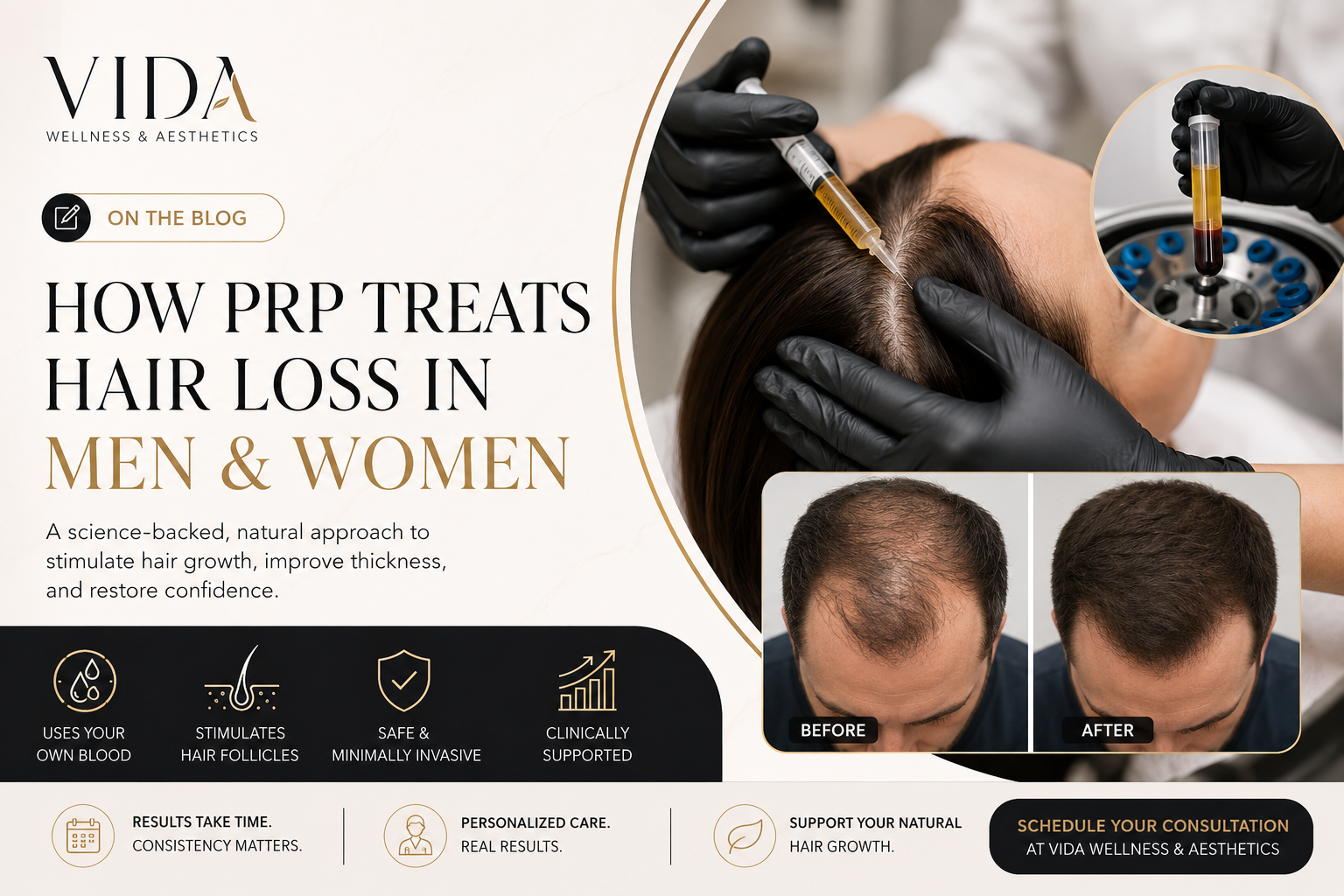
Hair loss affects far more people than many realize, touching up to 80% of white men and 40% of women at some point in their lives, and it often carries a real emotional weight beyond the physical change. While there are many products on the market promising to slow or reverse hair loss, platelet-rich plasma (PRP) therapy has emerged as one of the most evidence-supported, minimally invasive options available today. At Vida Wellness & Aesthetics, PRP hair restoration is one of our most requested treatments, and for good reason.
What Is PRP, Exactly?
Platelet-rich plasma is derived from your own blood. During treatment, a small blood sample is drawn, much like a routine blood test, and then processed in a centrifuge to separate and concentrate the platelets, which are rich in growth factors. This concentrated plasma is then injected into areas of the scalp experiencing thinning or hair loss.
Because PRP uses your own blood, it is considered an autologous therapy, meaning there is no risk of allergic reaction to a foreign substance and minimal risk of rejection. This is part of why PRP has gained popularity as a regenerative approach across multiple areas of medicine, not just hair restoration.
How Does PRP Actually Help Hair Growth?
The growth factors concentrated in platelet-rich plasma play a role in stimulating dormant hair follicles, improving blood supply to the scalp, and supporting the natural hair growth cycle. Rather than introducing a foreign substance or medication, PRP works by amplifying your body’s own regenerative signals at the follicular level, encouraging follicles in a resting phase to re-enter an active growth phase.
What Does the Research Say?
PRP for hair loss has been studied extensively in recent years, and the body of evidence has grown considerably. A comprehensive review of clinical trials evaluating PRP for androgenetic alopecia, the most common form of pattern hair loss in both men and women, found that the majority of studies demonstrated meaningful improvements in hair density and thickness. Combining PRP with complementary treatments such as microneedling or topical minoxidil showed enhanced results in several studies, suggesting PRP can work well both as a standalone treatment and alongside other hair restoration strategies.
For women specifically, a systematic review and meta-analysis examining 21 randomized controlled trials with over 600 participants found that PRP effectively improved hair density and thickness in women experiencing hair loss, with a favorable safety profile overall. The review also noted that results can vary based on dosage, treatment frequency, and individual factors, which is part of why a personalized treatment plan matters more than a generic protocol.
A separate meta-analysis covering more than 40 randomized controlled trials and nearly 1,900 participants found that properly activated PRP was effective at increasing hair density and reducing the recurrence of hair loss compared with placebo, while noting that non-activated PRP preparations were linked to a higher rate of side effects, underscoring the importance of proper technique and preparation.
Who Is a Good Candidate for PRP Hair Restoration?
PRP tends to work best for people in the earlier to moderate stages of hair thinning, where follicles are weakened but not completely dormant or scarred. It is commonly used for androgenetic alopecia (pattern hair loss) in both men and women, early-stage thinning before significant bald patches develop, and as a complementary treatment alongside other hair restoration approaches like minoxidil or microneedling.
PRP is generally less effective for areas with long-term, complete hair loss where follicles are no longer present, since the treatment works by stimulating existing follicles rather than creating new ones. A proper scalp evaluation is the best way to determine whether PRP alone, or PRP combined with another treatment, will offer the most benefit for your specific pattern of hair loss.
What to Expect During Treatment
A typical PRP session begins with a blood draw, followed by processing in a centrifuge to isolate the platelet-rich plasma, and finally a series of small injections into the treatment areas of the scalp. Most patients describe mild discomfort during the injections, often manageable with a topical numbing agent. There is little to no downtime, and most people return to normal activities the same day.
How Many Sessions Are Needed?
Because hair growth happens in cycles, PRP is typically administered as a series of treatments, often spaced four to six weeks apart for the initial series, followed by periodic maintenance sessions. Clinical studies showing significant improvement often involve three or more treatment cycles, with results becoming more visible over several months as new growth cycles take effect. Maintenance treatments are usually recommended to sustain results over time, since PRP supports existing follicles rather than permanently altering the underlying causes of hair loss.
Is PRP Safe?
PRP has a strong overall safety profile, largely because it uses a patient’s own blood rather than introducing external substances. Reported side effects are generally mild and may include temporary redness, swelling, or tenderness at injection sites. Research has consistently found PRP to be both safe and effective when properly prepared and administered, although results and outcomes can vary from person to person.
Our Approach at Vida Wellness & Aesthetics
Hair loss can affect confidence just as much as appearance, which is why we approach PRP hair restoration with the same personalized philosophy we bring to all of our treatments. Every PRP consultation includes a thorough scalp evaluation, an honest conversation about realistic expectations, and a treatment plan designed around your specific pattern of hair loss, not a generic package.
Considering PRP for Hair Restoration?
If thinning hair has been on your mind, schedule a consultation with Vida Wellness & Aesthetics to find out whether PRP therapy is the right path forward for you.
This article is for informational purposes only and is not a substitute for professional medical advice. Individual results vary, and a licensed provider can help determine the best treatment for your specific needs.